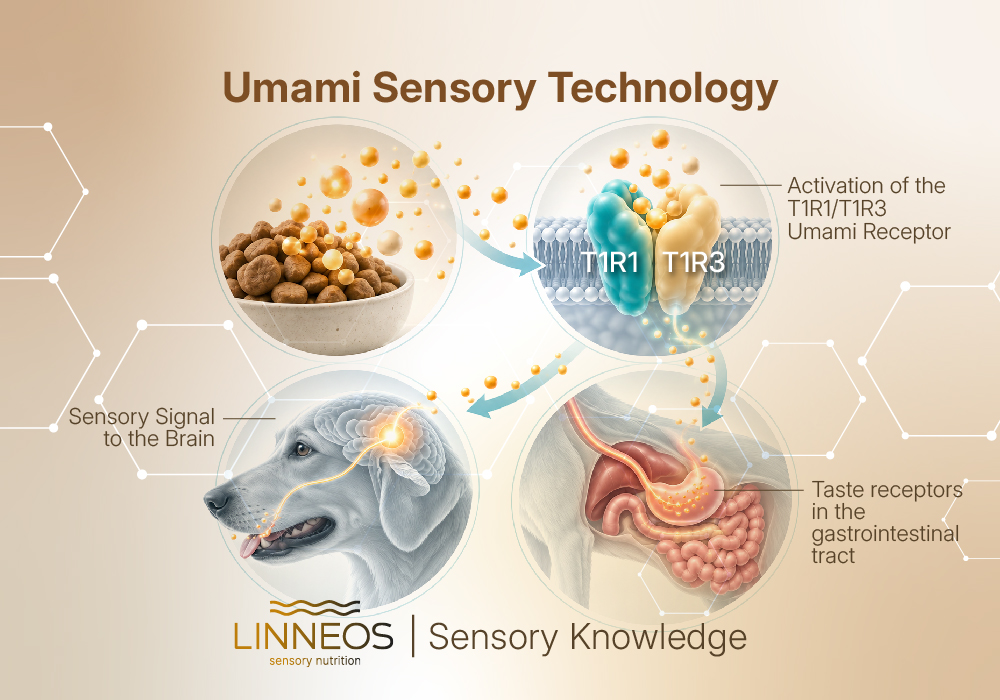
The science of palatability is driven directly by gene expression, specifically the T1R1/T1R3 heterodimer receptor complex that governs the umami taste. Encoded by the Tas1R gene family, T1R1 identifies amino acids and umami-related ligands, while T1R3 acts as the signaling partner, which is also shared with the sweet taste receptor (T1R2)
When proteins, free amino acids, nucleotides or glutamate reach the oral cavity, they bind to the extracellular detection sites of these receptors. This binding changes the receptor’s shape, activating intracellular signaling pathways that trigger neurotransmitter signals directly to the brain.
Key Mechanisms of Umami Sensorial Technology:
· The Nucleotide Multiplier: Umami perception is exponentially potentiated when combined with nucleotides like IMP (Inosine monophosphate) and GMP (Guanosine Monophosphate).
· Beyond the Mouth: Taste receptors are not restricted to the oral mucosa. They are also active in the epithelial and enteroendocrine cells of the gastrointestinal tract, where they can detect proteins and influence nutrient transport, motility, and digestive secretions.
Receptor expression varies significantly across species, debunking outdated myths about animal taste perception.
| Species Group | Receptor Expression Profile |
| Carnivores (Cats/Dogs) | High numbers of T1R1/T1R3 umami complex is the dominant cellular receptor, especially in cats. |
| Omnivores (Pigs) | Express high numbers of both umami and sweet receptors; respond strongly to a wider variety of amino acids than humans and detect sweet taste very similar to us. |
| Ruminants | Contrary to popular belief, possess numerous umami and sweet receptors throughout the tongue and oral mucosa. |
| Poultry | The TAS1R family is heavily present in the beak and around the tongue, actively driving the bird’s selection of protein-rich ingredients. |
APSAPAL line (APSAPAL PETS m, APSAPAL SWINE, APSAPAL POULTRY, and APSAPAL RUMINANTS). utilizes this biological mapping to formulate species-specific, yeast-derived palatants, by naturally providing the exact profile of amino acids, glutamic acid, peptides, and nucleotides that each species’ receptors are looking for, maximizing feed acceptance.


