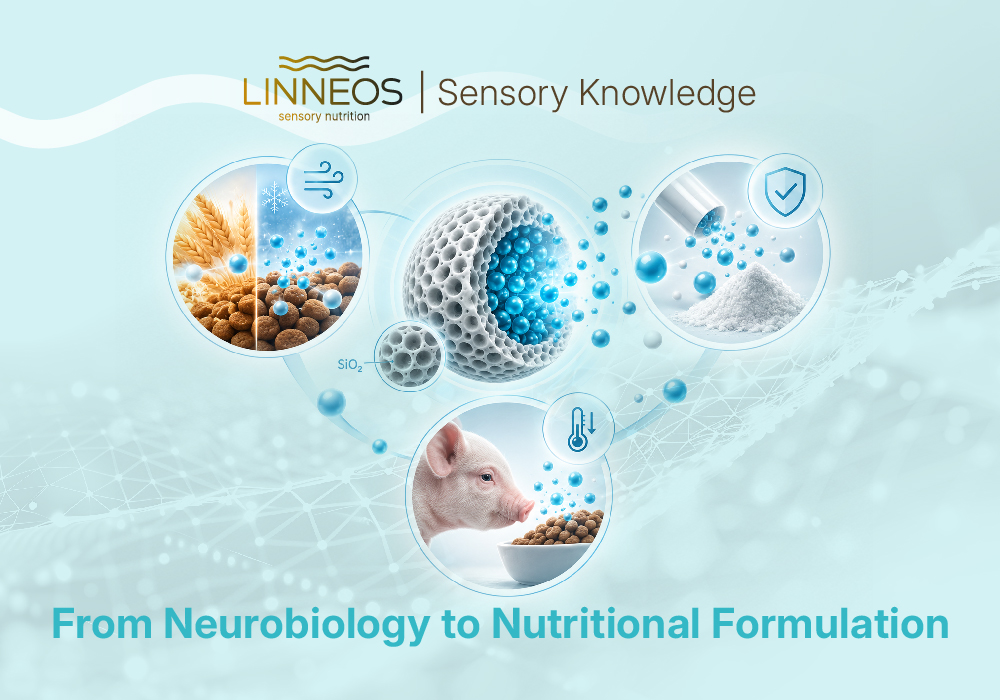
Protection, Flowability and Precision: The Value of Aroma Microbeads in Animal Feed Formulation
In Part 1, we explored how the olfactory system influences feed intake and feeding behaviour. However, understanding sensory biology is only the first step: the real challenge lies in ensuring that aromatic compounds remain stable within the feed matrix.
Aroma molecules are inherently volatile and heat-sensitive. Their degradation during industrial thermal processes, such as pelleting and extrusion, as well as during storage, can drastically reduce their effectiveness.
The Formulation Challenge
Traditionally, feed formulation has focused on meeting theoretical nutritional requirements, including protein, energy and amino acids.
The incorporation of microbead technology addresses critical operational challenges in feed manufacturing:
| Formulation Challenge | Function of Microbead Technology |
|---|---|
| Raw material variability | Masks olfactory variations associated with changes in ingredient origin or seasonality. |
| Inclusion of agro-industrial by-products | Blocks or mitigates undesirable sensory notes (off-notes) derived from medications, additives or by-products. |
| Reduced feed intake during periods of stress | Maintains hedonic stimulation during weaning, heat stress or vaccination periods. |
Silica-Based Aroma Microbead Technology (Silica-Based Flavour Beads)
To protect volatile molecules, at LINNEOS we use a porous matrix of amorphous silica (SiO₂).
Through a highly precise physical adsorption process, aromatic compounds are captured within the solid structure of the carrier (Johnson et al., 2017).
This mesoporous matrix acts as a controlled-release system (Zhao et al., 2013; He et al., 2015), providing four key advantages:
- Thermal and physical protection: Protects volatile compounds against the high temperatures and pressures involved in conditioning, pelleting and extrusion.
- Excellent flowability and handling: Facilitates industrial handling and precise dosing during feed manufacturing.
- Homogeneous distribution: Ensures uniform mixing throughout the feed, preventing animals from selectively consuming individual ingredients at the feeder.
- Progressive release: Maintains prolonged aroma diffusion throughout the product’s shelf life (controlled-release systems).
APSAROM® Solutions: Species-Specific Multisensory Synergy
Our APSAROM® range combines microbead technology with specific aromatic profiles tailored to the biology of each species:
- Fruity Range (Citrus, Apple, Banana, Red Berries): Designed to enhance freshness and attraction during early feeding stages.
- Herbal and Spiced Range (Anise, Thyme, Cinnamon, Molasses-Anise): Ideal for perinatal flavour imprinting in pigs and sensory stimulation in ruminants.
- Dairy and Vanilla Range (Sweet Milk, Dairy-Vanilla, Cream): Developed to mimic the nursing experience in piglets and calves.
- Meaty Range (Roasted, Meaty and Fried Chicken Notes): Solutions formulated to meet the high palatability requirements of pet food.
Conclusion
Nutritional formulation and sensory stimulation are not independent strategies, but essential complementary tools.
True innovation emerges from the perfect synergy between:
Ingredient + Technology + Application.
References — Part 2
He, Y., Peng, Y., & Chen, Y. (2015). Mesoporous silica materials as carriers for controlled release systems. Journal of Materials Chemistry B, 3(31), 6377–6390. https://doi.org/10.1039/C5TB00678D
Johnson, M., et al. (2017). Porous carriers for flavoring compounds. Food & Function, 8(4), 1627–1640. https://doi.org/10.1039/C6FO01579D
Zhao, Y., et al. (2013). Mesoporous silica nanoparticles for controlled delivery of bioactive compounds. Nanoscale, 5(12), 5083–5098. https://doi.org/10.1039/C3NR00958D


