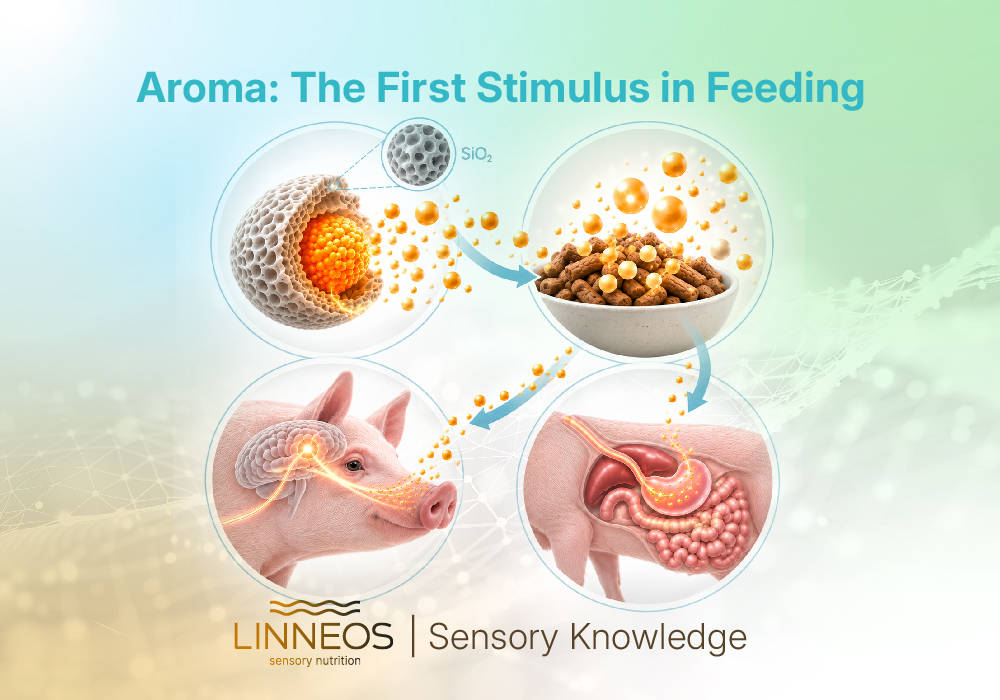
The Neurobiology of Olfaction in Animal Feed Intake
We often associate palatability exclusively with taste. However, an animal’s attraction to food begins before the first bite: it starts with the sense of smell.
When analysing animal nutrition, attention typically focuses on nutritional balance — optimal percentages of protein, fat, fibre and ash — digestibility and metabolic efficiency. However, before feed can be consumed and metabolised, it must first be accepted. During this initial interaction, olfaction acts as a primary and decisive sensory mechanism influencing feed intake.
Volatile compounds enable animals to recognise feed, anticipate its nutritional value and even activate physiological responses associated with appetite and digestion.
What Happens When an Animal Smells Feed?
There is a widespread belief that 80% of flavour depends on aroma. Although this percentage lacks robust scientific evidence, there is broad scientific consensus that retronasal olfaction plays a fundamental role in flavour perception — the integrated sensory experience combining smell, taste, texture and trigeminal sensations (Hummel, 2008; Hummel et al., 2012; Murphy et al., 1977).
Odour provides the brain with its first information about what the animal is about to consume.
The olfactory process involves a rapid neurophysiological cascade that directly connects the external environment with the animal’s emotional and instinctive brain:
- Detection of volatile compounds: Aromatic compounds released from the feed matrix travel through the air (orthonasal olfaction) or reach the nasal cavity through the nasopharynx during chewing (retronasal olfaction).
- Receptor activation: These molecules bind to olfactory receptors located on sensory neurons in the nasal epithelium.
- Neural processing: Signals are transmitted to the olfactory bulb and directly to the limbic system, particularly the amygdala and piriform cortex, initially bypassing conscious thalamocortical pathways.
This anatomical connection makes olfaction uniquely capable of triggering memories, reducing neophobia and inducing digestive cephalic-phase responses — including salivary, gastric and pancreatic secretions — before feed intake.
Aromas in Animal Nutrition: A Comparative Sensory Approach
- Olfaction is the first sense involved in feed selection.
- Olfactory evaluation takes place before taste perception.
- This occurs in both domestic and wild animals.
Responses to aromatic stimuli are not uniform across the animal kingdom. Different species have developed unique neurosensory adaptations shaped by their evolution, anatomy and feeding habits (Roura et al., 2008; Ache & Young, 2005).
While omnivorous mammals such as pigs and dogs, as well as obligate carnivores such as domestic cats, rely heavily on olfaction to select specific nutrients, ruminants and birds process and integrate aromatic signals through markedly different mechanisms.
In pigs, a high sensitivity to sweet and umami notes is particularly noteworthy and can be strategically leveraged from the earliest stages of life. Through the phenomenon of maternal flavour continuity, volatile molecules such as anethole or vanillin added to the sow’s diet can be transferred into maternal milk. Replicating the same aromatic profile in creep feed promotes recognition through familiarity, significantly reducing post-weaning stress and feed refusal (López-Vergé et al., 2021; Aagaard Schild & Rørvang, 2023; Jacela et al., 2010).
In contrast, in small and large ruminants, the influence of aroma extends throughout the digestive process, as chewing and rumination continuously enhance retronasal olfaction. This allows the inclusion of specific aromatic profiles to reshape feeding preferences, increasing the intake of high-fibre rations or diets containing raw materials with initially lower palatability (Baumont, 1996; Robertson et al., 2006; Vasta et al., 2012).
In companion animal nutrition, there is a clear physiological contrast between dogs and cats. While dogs tend to prefer meaty, fatty and strongly umami profiles, cats exhibit a unique genetic limitation: because their sweet taste receptor gene (Tas1r2) is inactive, feed acceptance does not depend on sugars but is strongly influenced by volatile compounds and specific amino acids associated with meaty flavours (Li et al., 2005; Bradshaw, 2006).
Finally, poultry nutrition challenges the traditional assumption that birds depend almost exclusively on vision and texture. Recent scientific literature confirms the presence of a functional olfactory system in birds, which plays an important role in fine feed discrimination and contributes to consistent feed intake across flocks.
Aroma, Food Memory and Voluntary Feed Intake
Olfaction acts as a major modulator of hedonic memory in animals.
Through the detection of specific aromatic profiles (flavour profiles) — unique and identifiable combinations of volatile molecules — the animal’s brain records a distinctive olfactory fingerprint.
This aromatic signature is rapidly recognised and remembered, allowing the animal to associate the stimulus with the post-ingestive metabolic consequences of the diet:
- Positive association: An aroma associated with high energy intake, digestive wellbeing or the reassurance of maternal learning promotes repeated, voluntary and confident feed consumption.
- Reduction of food neophobia: When introducing a new feed or changing a formulation, incorporating a familiar aroma helps reduce neophobia, lowering anxiety and shortening the time before the animal begins eating.
From Neurobiology to Practical Solutions
All this evidence raises a critical question in modern animal nutrition:
Are we formulating diets solely to meet nutritional requirements, or are we also stimulating the sensory systems that determine feed acceptance?
A perfectly balanced diet has little practical value if the animal rejects it or reduces its intake.
In everyday animal nutrition, there are numerous situations in which palatability may be severely compromised:
- Frequent changes in raw materials: Ingredient fluctuations driven by cost or availability alter the usual olfactory profile of feed, potentially causing unexpected rejection.
- Reduction in animal-derived proteins: The transition towards more plant-based diets often introduces bitter or astringent notes that reduce feed attractiveness.
- Inclusion of alternative raw materials or by-products: Ingredients with high organoleptic variability may introduce undesirable sensory notes (off-notes).
- Medicated diets: The inclusion of antibiotics, antiparasitic agents or corrective premixes can significantly alter the original taste and smell of feed, potentially causing sharp reductions in consumption.
- Periods of stress: Transitional stages such as weaning, regrouping or heat stress can lead to substantial reductions in appetite, requiring stronger sensory stimulation to encourage feed intake.
Conclusion
Nutritional formulation and sensory stimulation are not independent strategies, but complementary approaches.
Understanding how animals perceive feed makes it possible to design diets that are not only nutritionally balanced but also attractive and readily accepted.
The success of a nutritional strategy depends as much on diet formulation as on the sensory response it triggers in the animal.
Understanding the sensory response of each species is an essential starting point for achieving nutritional success.
In Part 2, we will explore how this scientific knowledge can be translated into nutritional formulation technology.
References — Part 1
Aagaard Schild, S. L., & Rørvang, M. V. (2023). Pig olfaction: the potential impact and use of odors in commercial pig husbandry. Frontiers in Animal Science, 4, 1144042.
Ache, B. W., & Young, J. M. (2005). Olfaction: Diverse Species, Conserved Principles. Neuron, 48(3), 417–430.
Baumont, R. (1996). Palatability and feeding behaviour in ruminants. A review. Annales de Zootechnie, 45(5), 385–400.
Hummel, T. (2008). Retronasal Perception of Odors. Chemistry & Biodiversity, 5(6), 853–861.
Hummel, T., Heilmann, S., et al. (2012). Retronasal perception of odors. Physiology & Behavior, 107(4), 484–487.
Jacela, J. Y., DeRouchey, J. M., Tokach, M. D., Goodband, R. D., Nelssen, J. L., Renter, D. G., & Dritz, S. S. (2010). Feed additives for swine: Fact sheets – flavors and sweeteners. Journal of Swine Health and Production, 18(3), 132–136.
López-Vergé, S., et al. (2021). Perinatal flavor learning and feed appetence in swine production. Animals, 11(4), 1052.
Murphy, C., Cain, W. S., & Bartoshuk, L. M. (1977). Mutual masking of odor and taste components in olfactory-taste mixtures. Sensory Processes, 1(4), 320–329.
Robertson, E., Gordon, I. J., & Pérez-Barbería, F. J. (2006). Preferences of sheep and goats for straw pellets treated with different food-flavouring agents. Small Ruminant Research, 63(1–2), 50–57.
Roura, E., Humphrey, B., Tedó, G., & Ipharraguerre, I. (2008). Unfolding the codes of short-term feed appetence in farm and companion animals. Canadian Journal of Animal Science, 88(4), 541–558.
Vasta, V., et al. (2012). Volatile organic compounds and palatability of concentrates fed to lambs and ewes. Small Ruminant Research, 105(1–3), 200–205.


